
SEO writing and copywriting are two essential branches of content marketing. Both play an important role in helping businesses reach their target audience and achieve specific goals. Content marketing involves creating and sharing valuable content across various platforms to attract potential customers and turn them into clients. This content may include blog posts, emails, videos, press releases, and other digital materials.
SEO writing and copywriting matter because they are strategically used to support different stages of the customer journey. While both involve writing content, they serve different purposes and require different approaches. In this article, we will explore the key differences between SEO writing and copywriting, and how content marketers use them together to achieve better results.
What is SEO writing?
SEO writing focuses on creating content that is optimized for search engines while remaining useful and readable for users. Its primary goal is to improve visibility in search results by aligning content with search intent, relevant keywords, and clear structure. SEO writing is commonly used in blog posts, guides, and informational articles designed to attract organic traffic over time.
What is Copywriting?
Copywriting, on the other hand, is focused on persuasion and action. Its main goal is to influence readers to take a specific step, such as signing up, purchasing a product, or clicking a link. Copywriting is commonly used in landing pages, advertisements, email campaigns, and product descriptions.
Now, let’s differentiate these two in this chart:
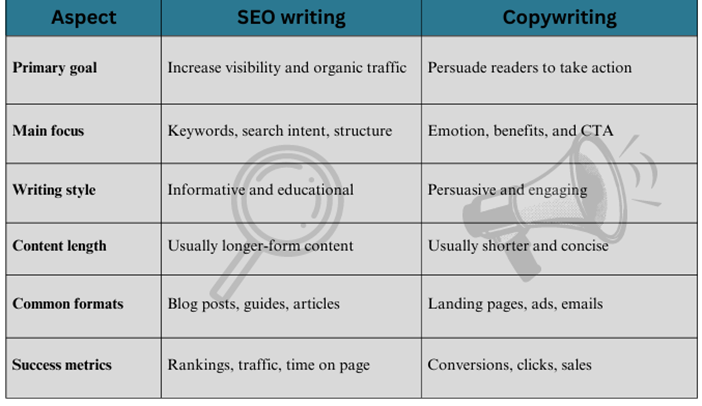
The chart above highlights the key differences between SEO writing and copywriting based on purpose, style, and goals.
When to use SEO writing or Copywriting?
Since we’ve already highlighted the key differences, deciding when to use SEO writing or copywriting becomes straightforward. SEO writing is used to align content with what your target audience is actively searching for. By creating SEO-optimized content, you can help potential clients find answers to their needs while improving your content’s ranking in search results and resonating with the intended audience.
Copywriting, on the other hand, is used to persuade potential customers to take action. It is commonly applied in ads, emails, landing pages, and product descriptions. As a versatile skill, copywriting can be applied across platforms to help businesses drive sales and expand their market reach.
How SEO writing and Copywriting work together?
The success of SEO writing and copywriting lies in their effective integration. Combining these elements allows businesses to create content that not only drives organic traffic but also converts visitors into loyal customers, leading to lasting results. This integrated approach is often called SEO copywriting. By understanding how these two elements work together, businesses can achieve more than just higher search rankings — they can also maintain a consistent brand voice across all digital platforms.
Conclusion
SEO writing and copywriting are two essential branches of content marketing, each serving distinct purposes. SEO writing attracts readers by improving visibility and aligning with search intent, while copywriting persuades them to take action. When combined effectively — through SEO copywriting — businesses can both drive traffic and convert visitors into loyal customers, all while maintaining a consistent brand voice. Understanding the differences, purposes, and synergy between these two approaches is key to creating a content strategy that delivers measurable results.